AlphaGeometry is an artificial intelligence (AI) program that can solve hard problems in Euclidean geometry. The system comprises a data-driven large language model (LLM) and a rule-based symbolic engine (Deductive Database Arithmetic Reasoning). It was developed by DeepMind, a subsidiary of Google. The program solved 25 geometry problems out of 30 from the International Mathematical Olympiad (IMO) under competition time limits—a performance almost as good as the average human gold medallist. For comparison, the previous AI program, called Wu's method, managed to solve only 10 problems. DeepMind published a paper about AlphaGeometry in the peer-reviewed journal Nature on 17 January 2024. AlphaGeometry was featured in MIT Technology Review on the same day. Traditional geometry programs are symbolic engines that rely exclusively on human-coded rules to generate rigorous proofs, which makes them lack flexibility in unusual situations. AlphaGeometry combines such a symbolic engine with a specialized large language model trained on synthetic data of geometrical proofs. When the symbolic engine doesn't manage to find a formal and rigorous proof on its own, it solicits the large language model, which suggests a geometrical construct to move forward. However, it is unclear how applicable this method is to other domains of mathematics or reasoning, because symbolic engines rely on domain-specific rules and because of the need for synthetic data. == AlphaGeometry 2 == AlphaGeometry 2 is an improved version of AlphaGeometry, published on February 5, 2025. They added more features to the representation language to describe more geometry problems that involve movements of objects, and problems containing linear equations of angles, ratios, and distances. They targeted IMO geometry questions from 2000 to 2024. The expanded representation language allowed them to cover 88% of the questions. It uses Gemini finetuned on a synthetically generated dataset of problems and solutions in the representation language. The model is used for making auxiliary constructions like lines and points, to help the tree search. It is also used for autoformalization, i.e. converting a problem in English to a problem in the representation language.
Synonym (database)
In databases, a synonym is an alias or alternate name for a table, view, sequence, or other schema object. They are used mainly to make it intuitive for users to access database objects owned by other users. They also hide the underlying object's identity and make it harder for a malicious program or user to target the underlying object (security through obscurity). Because a synonym is just an alternate name for an object, it requires no storage other than its definition. When an application uses a synonym, the DBMS forwards the request to the synonym's underlying base object. By coding your programs to use synonyms instead of database object names, you insulate yourself from any changes in the name, ownership, or object locations, at the cost of adding another layer that also needs to be maintained. Users can also have different needs, for example some may wish to use a shorter name to refer to database objects they often query, which can be done with aliases without having to rename the underlying object and alter the code referring to it. Synonyms are very powerful from the point of view of allowing users access to objects that do not lie within their schema. All synonyms have to be created explicitly with the CREATE SYNONYM command and the underlying objects can be located in the same database or in other databases that are connected by database links There are two major uses of synonyms: Object invisibility: Synonyms can be created to keep the original object hidden from the user. Location invisibility: Synonyms can be created as aliases for tables and other objects that are not part of the local database. When a table or a procedure is created, it is created in a particular schema, and other users can access it only by using that schema's name as a prefix to the object's name. The way around for this is for the schema owner creates a synonym with the same name as the table name. == Public synonyms == Public synonyms are owned by special schema in the Oracle Database called PUBLIC. As mentioned earlier, public synonyms can be referenced by all users in the database. Public synonyms are usually created by the application owner for the tables and other objects such as procedures and packages so the users of the application can see the objects The following code shows how to create a public synonym for the employee table: Now any user can see the table by just typing the original table name. If you wish, you could provide a different table name for that table in the CREATE SYNONYM statement. Remember that the DBA must create public synonyms. Just because you can see a table through public (or private) synonym doesn’t mean that you can also perform SELECT, INSERT, UPDATE or DELETE operations on the table. To be able to perform those operations, a user needs specific privileges for the underlying object, either directly or through roles from the application owner. == Private synonyms == A private synonym is a synonym within a database schema that a developer typically uses to mask the true name of a table, view stored procedure, or other database object in an application schema. Private synonyms, unlike public synonyms, can be referenced only by the schema that owns the table or object. You may want to create private synonyms when you want to refer to the same table by different contexts. Private synonym overrides public synonym definitions. You create private synonyms the same way you create public synonyms, but you omit the PUBLIC keyword in the CREATE statement. The following example shows how to create a private synonym called addresses for the locations table. Note that once you create the private synonym, you can refer to the synonym exactly as you would the original table name. == Drop a synonym == Synonyms, both private and public, are dropped in the same manner by using the DROP SYNONYM command, but there is one important difference. If you are dropping a public synonym; you need to add the keyword PUBLIC after the keyword DROP. The ALL_SYNONYMS (or DBA_SYNONYMS) view provides information on all synonyms in your database.
Feature engineering
Feature engineering is a preprocessing step in supervised machine learning and statistical modeling which transforms raw data into a more effective set of inputs. Each input comprises several attributes, known as features. By providing models with relevant information, feature engineering significantly enhances their predictive accuracy and decision-making capability. Beyond machine learning, the principles of feature engineering are applied in various scientific fields, including physics. For example, physicists construct dimensionless numbers such as the Reynolds number in fluid dynamics, the Nusselt number in heat transfer, and the Archimedes number in sedimentation. They also develop first approximations of solutions, such as analytical solutions for the strength of materials in mechanics. == Clustering == One of the applications of feature engineering has been clustering of feature-objects or sample-objects in a dataset. Especially, feature engineering based on matrix decomposition has been extensively used for data clustering under non-negativity constraints on the feature coefficients. These include Non-Negative Matrix Factorization (NMF), Non-Negative Matrix-Tri Factorization (NMTF), Non-Negative Tensor Decomposition/Factorization (NTF/NTD), etc. The non-negativity constraints on coefficients of the feature vectors mined by the above-stated algorithms yields a part-based representation, and different factor matrices exhibit natural clustering properties. Several extensions of the above-stated feature engineering methods have been reported in literature, including orthogonality-constrained factorization for hard clustering, and manifold learning to overcome inherent issues with these algorithms. Other classes of feature engineering algorithms include leveraging a common hidden structure across multiple inter-related datasets to obtain a consensus (common) clustering scheme. An example is Multi-view Classification based on Consensus Matrix Decomposition (MCMD), which mines a common clustering scheme across multiple datasets. MCMD is designed to output two types of class labels (scale-variant and scale-invariant clustering), and: is computationally robust to missing information, can obtain shape- and scale-based outliers, and can handle high-dimensional data effectively. Coupled matrix and tensor decompositions are popular in multi-view feature engineering. == Predictive modelling == Feature engineering in machine learning and statistical modeling involves selecting, creating, transforming, and extracting data features. Key components include feature creation from existing data, transforming and imputing missing or invalid features, reducing data dimensionality through methods like Principal Components Analysis (PCA), Independent Component Analysis (ICA), and Linear Discriminant Analysis (LDA), and selecting the most relevant features for model training based on importance scores and correlation matrices. Features vary in significance. Even relatively insignificant features may contribute to a model. Feature selection can reduce the number of features to prevent a model from becoming too specific to the training data set (overfitting). Feature explosion occurs when the number of identified features is too large for effective model estimation or optimization. Common causes include: Feature templates - implementing feature templates instead of coding new features Feature combinations - combinations that cannot be represented by a linear system Feature explosion can be limited via techniques such as regularization, kernel methods, and feature selection. == Automation == Automation of feature engineering is a research topic that dates back to the 1990s. Machine learning software that incorporates automated feature engineering has been commercially available since 2016. Related academic literature can be roughly separated into two types: Multi-relational Decision Tree Learning (MRDTL) uses a supervised algorithm that is similar to a decision tree. Deep Feature Synthesis uses simpler methods. === Multi-relational Decision Tree Learning (MRDTL) === Multi-relational Decision Tree Learning (MRDTL) extends traditional decision tree methods to relational databases, handling complex data relationships across tables. It innovatively uses selection graphs as decision nodes, refined systematically until a specific termination criterion is reached. Most MRDTL studies base implementations on relational databases, which results in many redundant operations. These redundancies can be reduced by using techniques such as tuple id propagation. === Open-source implementations === There are a number of open-source libraries and tools that automate feature engineering on relational data and time series: featuretools is a Python library for transforming time series and relational data into feature matrices for machine learning. MCMD: An open-source feature engineering algorithm for joint clustering of multiple datasets. OneBM or One-Button Machine combines feature transformations and feature selection on relational data with feature selection techniques. OneBM helps data scientists reduce data exploration time allowing them to try and error many ideas in short time. On the other hand, it enables non-experts, who are not familiar with data science, to quickly extract value from their data with a little effort, time, and cost. getML community is an open source tool for automated feature engineering on time series and relational data. It is implemented in C/C++ with a Python interface. It has been shown to be at least 60 times faster than tsflex, tsfresh, tsfel, featuretools or kats. tsfresh is a Python library for feature extraction on time series data. It evaluates the quality of the features using hypothesis testing. tsflex is an open source Python library for extracting features from time series data. Despite being 100% written in Python, it has been shown to be faster and more memory efficient than tsfresh, seglearn or tsfel. seglearn is an extension for multivariate, sequential time series data to the scikit-learn Python library. tsfel is a Python package for feature extraction on time series data. kats is a Python toolkit for analyzing time series data. === Deep feature synthesis === The deep feature synthesis (DFS) algorithm beat 615 of 906 human teams in a competition. == Feature stores == The feature store is where the features are stored and organized for the explicit purpose of being used to either train models (by data scientists) or make predictions (by applications that have a trained model). It is a central location where you can either create or update groups of features created from multiple different data sources, or create and update new datasets from those feature groups for training models or for use in applications that do not want to compute the features but just retrieve them when it needs them to make predictions. A feature store includes the ability to store code used to generate features, apply the code to raw data, and serve those features to models upon request. Useful capabilities include feature versioning and policies governing the circumstances under which features can be used. Feature stores can be standalone software tools or built into machine learning platforms. == Alternatives == Feature engineering can be a time-consuming and error-prone process, as it requires domain expertise and often involves trial and error. Deep learning algorithms may be used to process a large raw dataset without having to resort to feature engineering. However, deep learning algorithms still require careful preprocessing and cleaning of the input data. In addition, choosing the right architecture, hyperparameters, and optimization algorithm for a deep neural network can be a challenging and iterative process.
Machine learning in video games
Artificial intelligence and machine learning techniques are used in video games for a wide variety of applications such as non-player character (NPC) control, procedural content generation (PCG) and deep learning-based content generation. Machine learning is a subset of artificial intelligence that uses historical data to build predictive and analytical models. This is in sharp contrast to traditional methods of artificial intelligence such as search trees and expert systems. Information on machine learning techniques in the field of games is mostly known to public through research projects as most gaming companies choose not to publish specific information about their intellectual property. The most publicly known application of machine learning in games is likely the use of deep learning agents that compete with professional human players in complex strategy games. There has been a significant application of machine learning on games such as Atari/ALE, Doom, Minecraft, StarCraft, and car racing. Other games that did not originally exists as video games, such as chess and Go have also been affected by the machine learning. == Overview of relevant machine learning techniques == === Deep learning === Deep learning is a subset of machine learning which focuses heavily on the use of artificial neural networks (ANN) that learn to solve complex tasks. Deep learning uses multiple layers of ANN and other techniques to progressively extract information from an input. Due to this complex layered approach, deep learning models often require powerful machines to train and run on. ==== Convolutional neural networks ==== Convolutional neural networks (CNN) are specialized ANNs that are often used to analyze image data. These types of networks are able to learn translation invariant patterns, which are patterns that are not dependent on location. CNNs are able to learn these patterns in a hierarchy, meaning that earlier convolutional layers will learn smaller local patterns while later layers will learn larger patterns based on the previous patterns. A CNN's ability to learn visual data has made it a commonly used tool for deep learning in games. === Recurrent neural network === Recurrent neural networks are a type of ANN that are designed to process sequences of data in order, one part at a time rather than all at once. An RNN runs over each part of a sequence, using the current part of the sequence along with memory of previous parts of the current sequence to produce an output. These types of ANN are highly effective at tasks such as speech recognition and other problems that depend heavily on temporal order. There are several types of RNNs with different internal configurations; the basic implementation suffers from a lack of long term memory due to the vanishing gradient problem, thus it is rarely used over newer implementations. ==== Long short-term memory ==== A long short-term memory (LSTM) network is a specific implementation of a RNN that is designed to deal with the vanishing gradient problem seen in simple RNNs, which would lead to them gradually "forgetting" about previous parts of an inputted sequence when calculating the output of a current part. LSTMs solve this problem with the addition of an elaborate system that uses an additional input/output to keep track of long term data. LSTMs have achieved very strong results across various fields, and were used by several monumental deep learning agents in games. === Reinforcement learning === Reinforcement learning is the process of training an agent using rewards and/or punishments. The way an agent is rewarded or punished depends heavily on the problem; such as giving an agent a positive reward for winning a game or a negative one for losing. Reinforcement learning is used heavily in the field of machine learning and can be seen in methods such as Q-learning, policy search, Deep Q-networks and others. It has seen strong performance in both the field of games and robotics. === Neuroevolution === Neuroevolution involves the use of both neural networks and evolutionary algorithms. Instead of using gradient descent like most neural networks, neuroevolution models make use of evolutionary algorithms to update neurons in the network. Researchers claim that this process is less likely to get stuck in a local minimum and is potentially faster than state of the art deep learning techniques. == Deep learning agents == Machine learning agents have been used to take the place of a human player rather than function as NPCs, which are deliberately added into video games as part of designed gameplay. Deep learning agents have achieved impressive results when used in competition with both humans and other artificial intelligence agents. === Chess === Chess is a turn-based strategy game that is considered a difficult AI problem due to the computational complexity of its board space. Similar strategy games are often solved with some form of a Minimax Tree Search. These types of AI agents have been known to beat professional human players, such as the historic 1997 Deep Blue versus Garry Kasparov match. Since then, machine learning agents have shown ever greater success than previous AI agents. === Go === Go is another turn-based strategy game which is considered an even more difficult AI problem than chess. The state space of is Go is around 10^170 possible board states compared to the 10^120 board states for Chess. Prior to recent deep learning models, AI Go agents were only able to play at the level of a human amateur. ==== AlphaGo ==== Google's 2015 AlphaGo was the first AI agent to beat a professional Go player. AlphaGo used a deep learning model to train the weights of a Monte Carlo tree search (MCTS). The deep learning model consisted of 2 ANN, a policy network to predict the probabilities of potential moves by opponents, and a value network to predict the win chance of a given state. The deep learning model allows the agent to explore potential game states more efficiently than a vanilla MCTS. The network were initially trained on games of humans players and then were further trained by games against itself. ==== AlphaGo Zero ==== AlphaGo Zero, another implementation of AlphaGo, was able to train entirely by playing against itself. It was able to quickly train up to the capabilities of the previous agent. === StarCraft series === StarCraft and its sequel StarCraft II are real-time strategy (RTS) video games that have become popular environments for AI research. Blizzard and DeepMind have worked together to release a public StarCraft 2 environment for AI research to be done on. Various deep learning methods have been tested on both games, though most agents usually have trouble outperforming the default AI with cheats enabled or skilled players of the game. ==== Alphastar ==== Alphastar was the first AI agent to beat professional StarCraft 2 players without any in-game advantages. The deep learning network of the agent initially received input from a simplified zoomed out version of the gamestate, but was later updated to play using a camera like other human players. The developers have not publicly released the code or architecture of their model, but have listed several state of the art machine learning techniques such as relational deep reinforcement learning, long short-term memory, auto-regressive policy heads, pointer networks, and centralized value baseline. Alphastar was initially trained with supervised learning, it watched replays of many human games in order to learn basic strategies. It then trained against different versions of itself and was improved through reinforcement learning. The final version was hugely successful, but only trained to play on a specific map in a protoss mirror matchup. === Dota 2 === Dota 2 is a multiplayer online battle arena (MOBA) game. Like other complex games, traditional AI agents have not been able to compete on the same level as professional human player. The only widely published information on AI agents attempted on Dota 2 is OpenAI's deep learning Five agent. ==== OpenAI Five ==== OpenAI Five utilized separate long short-term memory networks to learn each hero. It trained using a reinforcement learning technique known as Proximal Policy Learning running on a system containing 256 GPUs and 128,000 CPU cores. Five trained for months, accumulating 180 years of game experience each day, before facing off with professional players. It was eventually able to beat the 2018 Dota 2 esports champion team in a 2019 series of games. === Planetary Annihilation === Planetary Annihilation is a real-time strategy game which focuses on massive scale war. The developers use ANNs in their default AI agent. === Supreme Commander 2 === Supreme Commander 2 is a real-time strategy (RTS) video game. The game uses Multilayer Perceptrons (MLPs) to control a platoon’s reaction to encountered enemy units. Total of four MLPs are used, one for each platoon type: land, naval
Cognitive philology
Cognitive philology is the science that studies written and oral texts as the product of human mental processes. Studies in cognitive philology compare documentary evidence emerging from textual investigations with results of experimental research, especially in the fields of cognitive and ecological psychology, neurosciences and artificial intelligence. "The point is not the text, but the mind that made it". Cognitive Philology aims to foster communication between literary, textual, philological disciplines on the one hand and researches across the whole range of the cognitive, evolutionary, ecological and human sciences on the other. Cognitive philology: investigates transmission of oral and written text, and categorization processes which lead to classification of knowledge, mostly relying on the information theory; studies how narratives emerge in so called natural conversation and selective process which lead to the rise of literary standards for storytelling, mostly relying on embodied semantics; explores the evolutive and evolutionary role played by rhythm and metre in human ontogenetic and phylogenetic development and the pertinence of the semantic association during processing of cognitive maps; Provides the scientific ground for multimedia critical editions of literary texts. Among the founding thinkers and noteworthy scholars devoted to such investigations are: Alan Richardson: Studies Theory of Mind in early-modern and contemporary literature. Anatole Pierre Fuksas Benoît de Cornulier David Herman: Professor of English at North Carolina State University and an adjunct professor of linguistics at Duke University. He is the author of "Universal Grammar and Narrative Form" and the editor of "Narratologies: New Perspectives on Narrative Analysis". Domenico Fiormonte François Recanati Gilles Fauconnier, a professor in Cognitive science at the University of California, San Diego. He was one of the founders of cognitive linguistics in the 1970s through his work on pragmatic scales and mental spaces. His research explores the areas of conceptual integration and compressions of conceptual mappings in terms of the emergent structure in language. Julián Santano Moreno Luca Nobile Manfred Jahn in Germany Mark Turner Paolo Canettieri
FastTrack Automation Studio
FastTrack Automation Studio (formerly known as FastTrack Scripting Host), often referred to as just FastTrack, is a scripting language for Windows IT System Administrators. The product’s goal is to handle any kind of scripting that might be required to automate processes with Microsoft Windows networks. == Manufacturer == FastTrack is produced by FastTrack Software, which is headquartered in Aalborg, Denmark. The product is promoted by the manufacturer as a one-stop shop for Windows script writers and its development paradigm is “one operation = one script line”. Script writers use a purpose-built editor to create scripts, inserting script lines via menus, drag’n drop, or simply typing them in. Scripts may be used out of the box, created from scratch, imported from forums or other users, or customized from product documentation. == Types of scripts == Simple scripts include: Outlook Signatures Login scripts Backup and replication scripts Inventory and asset management Automated Windows OS installation and deployment Automated application software deployment Active Directory scripts More advanced scripts include: SCCM task sequences Citrix ICA and RDP Clients built-in Deploying applications to server farms Deploying GPO MSI files SQL Server scripts == Basic structure == Under the hood, scripts comprise commands, functions, collections, and conditions. When a script is executed these components are converted into many lines of C# code, sometimes hundreds of lines, depending on the particular script operation. Scripts can be compiled into EXE files or MSI packages and treated as standalone Windows applications. == History == FastTrack Scripting Host (FastTrack) was first developed around 2006 to ease the administration burden of IT System Administrators on Windows networks. === Product idea === The idea for the product came from founder and President of FastTrack Software, Lars Pedersen, who has a background in systems administration. Previously with Telenor, Denmark’s major telephone company, Pedersen performed various roles in systems administration, programming and web development. He also worked as a consultant and developer on several major projects at various companies in Europe. Dissatisfied from his own experiences and frustrations administering Windows networks, Pederson looked for a way to make life easier for system administrators. In particular, he wanted something that could minimize the amount of time needed each day to perform routine and mundane tasks, which was a waste of time and expertise that should have been committed to other projects. === Development === Leading a small team of developers, Pedersen developed FastTrack Scripting Host to simplify and automate the routine tasks of system administrators. The resulting product is definitely a scripting language, but it can be used intuitively like a programming language, without requiring users to learn syntax or other concepts typically associated with programming languages. === Marketing === In April 2010, FastTrack Software entered into an agreement with Binary Research International Archived 2008-10-15 at the Wayback Machine, based in the city of Milwaukee, United States to market and sell the product globally. === Awards === FSH received a Windows IT Pro Community Choice award in 2012. == Versions == The first version was produced in June 2006 and contained 51 components, which are the commands, functions, conditions and collections making up FastTrack. The following table summarizes dates and components for major releases. Companies and organizations such as NOAA, Kawasaki, and Goodyear have used and implemented the FastTrack Scripting Host. == Comparison with other scripting software == FastTrack Scripting Host Kixtart PowerShell ScriptLogic VBScript
Cognitive robotics
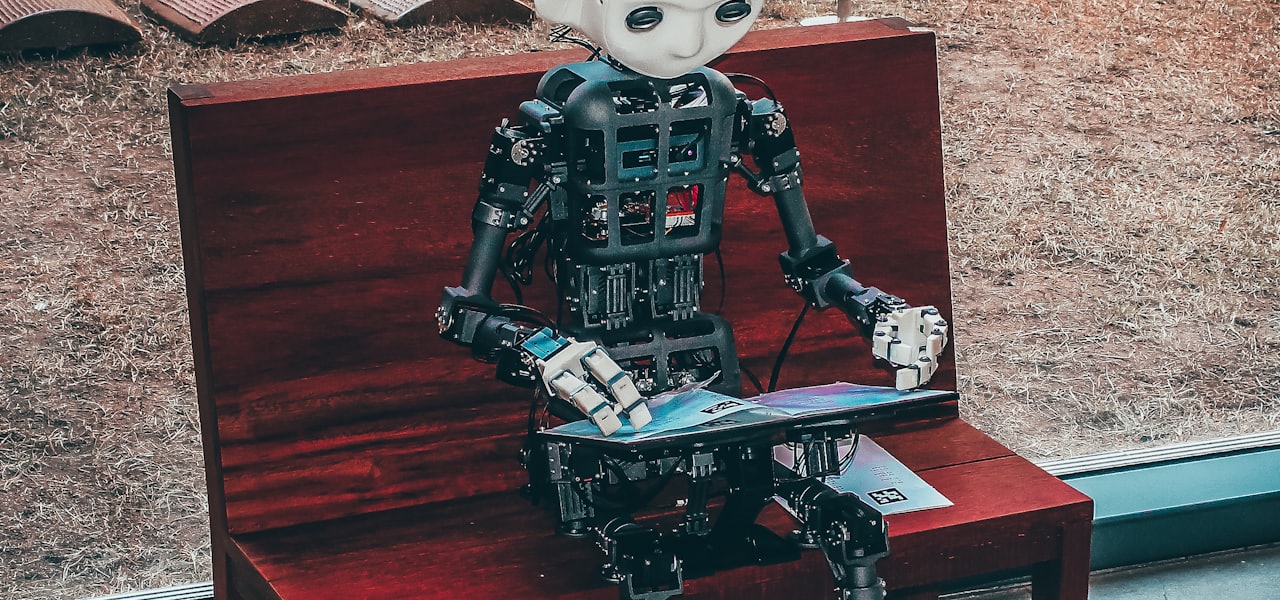
Cognitive robotics or cognitive technology is a subfield of robotics concerned with endowing a robot with intelligent behavior by providing it with a processing architecture that will allow it to learn and reason about how to behave in response to complex goals in a complex world. Cognitive robotics may be considered the engineering branch of embodied cognitive science and embodied embedded cognition, consisting of robotic process automation, artificial intelligence, machine learning, deep learning, optical character recognition, image processing, process mining, analytics, software development and system integration. == Core issues == While traditional cognitive modeling approaches have assumed symbolic coding schemes as a means for depicting the world, translating the world into these kinds of symbolic representations has proven to be problematic if not untenable. Perception and action and the notion of symbolic representation are therefore core issues to be addressed in cognitive robotics. == Starting point == Cognitive robotics views human or animal cognition as a starting point for the development of robotic information processing, as opposed to more traditional artificial intelligence techniques. Target robotic cognitive capabilities include perception processing, attention allocation, anticipation, planning, complex motor coordination, reasoning about other agents and perhaps even about their own mental states. Robotic cognition embodies the behavior of intelligent agents in the physical world (or a virtual world, in the case of simulated cognitive robotics). Ultimately, the robot must be able to act in the real world. == Learning techniques == === Motor Babble === A preliminary robot learning technique called motor babbling involves correlating pseudo-random complex motor movements by the robot with resulting visual and/or auditory feedback such that the robot may begin to expect a pattern of sensory feedback given a pattern of motor output. Desired sensory feedback may then be used to inform a motor control signal. This is thought to be analogous to how a baby learns to reach for objects or learns to produce speech sounds. For simpler robot systems, where, for instance, inverse kinematics may feasibly be used to transform anticipated feedback (desired motor result) into motor output, this step may be skipped. === Imitation === Once a robot can coordinate its motors to produce a desired result, the technique of learning by imitation may be used. The robot monitors the performance of another agent and then the robot tries to imitate that agent. It is often a challenge to transform imitation information from a complex scene into a desired motor result for the robot. Note that imitation is a high-level form of cognitive behavior and imitation is not necessarily required in a basic model of embodied animal cognition. === Knowledge acquisition === A more complex learning approach is "autonomous knowledge acquisition": the robot is left to explore the environment on its own. A system of goals and beliefs is typically assumed. A somewhat more directed mode of exploration can be achieved by "curiosity" algorithms, such as Intelligent Adaptive Curiosity or Category-Based Intrinsic Motivation. These algorithms generally involve breaking sensory input into a finite number of categories and assigning some sort of prediction system (such as an artificial neural network) to each. The prediction system keeps track of the error in its predictions over time. Reduction in prediction error is considered learning. The robot then preferentially explores categories in which it is learning (or reducing prediction error) the fastest. == Other architectures == Some researchers in cognitive robotics have tried using architectures such as (ACT-R and Soar (cognitive architecture)) as a basis of their cognitive robotics programs. These highly modular symbol-processing architectures have been used to simulate operator performance and human performance when modeling simplistic and symbolized laboratory data. The idea is to extend these architectures to handle real-world sensory input as that input continuously unfolds through time. What is needed is a way to somehow translate the world into a set of symbols and their relationships. == Questions == Some of the fundamental questions to be answered in cognitive robotics are: How much human programming should or can be involved to support the learning processes? How can one quantify progress? Some of the adopted ways are reward and punishment. But what kind of reward and what kind of punishment? In humans, when teaching a child, for example, the reward would be candy or some encouragement, and the punishment can take many forms. But what is an effective way with robots?